

A Qatar expansion can create tax exposure before an overseas operation becomes profitable. Cross-border tax structuring aligns how income, financing, royalties, and service fees are arranged with the rules in each jurisdiction. It also assesses treaty relief, foreign tax credits, withholding taxes, and whether local activity creates a taxable permanent establishment. The key question is not simply where a company is incorporated, but which jurisdictions may tax specific income and on what basis.
Businesses entering new markets face a familiar risk: a structure designed around one country’s rules can create unexpected obligations elsewhere. This guide explains how cross-border taxation affects Qatar businesses, how double taxation relief and foreign tax credits may work, and which facts shape permanent establishment exposure. It also covers international financing, licensing, and service arrangements, including transfer pricing and withholding tax. The analysis depends on destination-country rules, treaty access, the company’s actual functions, and payment records, not a single template for every market.
Key Takeaways
- Map where income may be taxed before entering a foreign market, then assess treaty relief and reporting requirements across the jurisdictions involved.
- Evaluate employees’ overseas work arrangements against the activities and business presence that could create permanent establishment exposure.
- Review financing, licensing, and service payments together, including withholding treatment and whether related-party pricing reflects the arm’s-length principle.
- Assess foreign tax credits and exemptions alongside the relevant tax rules, since relief depends on how each jurisdiction treats the income and tax paid.
- Keep lawful tax planning distinct from evasion by aligning the structure with genuine business activity, applicable rules, and transparent reporting.
Tax avoidance of double taxation and mitigation of single taxation
For Qatar businesses, cross-border tax planning means comparing how each jurisdiction treats the same income. Treaty relief, foreign tax credits, withholding rules, and reporting obligations determine whether income may be taxed twice or left outside taxation altogether.
Double Tax Treaty Analysis
Start a treaty analysis by identifying the income, taxpayer, and jurisdictions asserting taxing rights. The relevant agreement may allocate rights differently for business profits, dividends, interest, or royalties. Review its definitions, residence rules, permanent establishment provisions, and relief method. Then compare those terms with the company’s actual operations and records, rather than relying only on incorporation documents.
Double taxation agreements can limit overlapping tax claims, but access depends on treaty conditions and the facts. Map each income stream to the relevant agreement, then record which jurisdiction may tax it and how relief can be claimed. Qatar businesses should also assess whether their structure meets the treaty’s residence and beneficial ownership requirements.
Withholding Tax Treatment
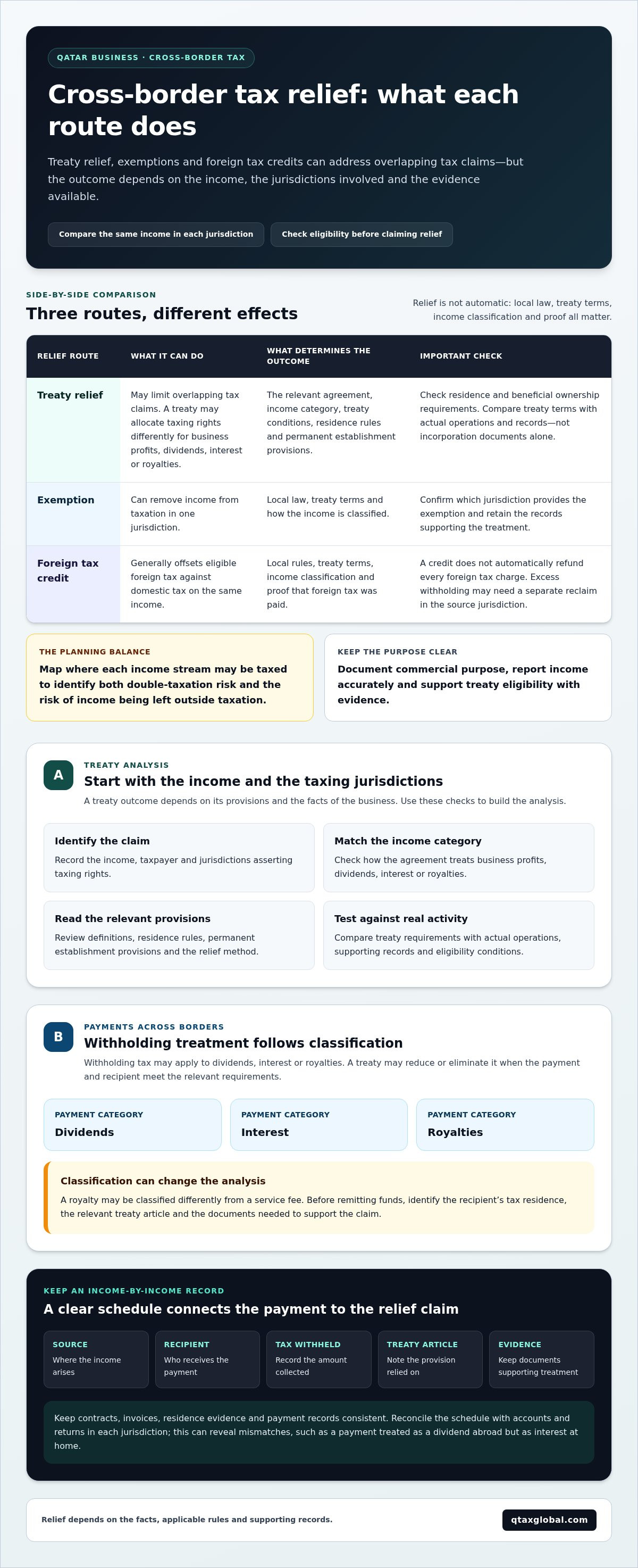
Withholding tax may apply when a business pays dividends, interest, or royalties across borders. A treaty may reduce or eliminate it, depending on the payment’s classification and eligibility requirements. Before a Qatar entity remits funds, identify the recipient’s tax residence, the relevant treaty article, and the documents needed to support the claim. Record the tax withheld so it can be reconciled later.
Compare the treaty outcome with domestic withholding rules in both jurisdictions. For example, a royalty may be classified differently from a service fee, changing the analysis. Keep contracts, invoices, residence evidence, and payment records consistent. This supports a clear filing position and helps determine whether a credit or exemption may address tax already collected.
Relief mechanisms differ. An exemption can remove income from taxation in one jurisdiction, while a foreign tax credit generally offsets eligible foreign tax against domestic tax on the same income. Available relief depends on local law, treaty terms, income classification, and proof of tax paid. A credit does not automatically refund every foreign tax charge. Excess withholding may require a separate reclaim in the source jurisdiction.
Prepare an income-by-income schedule before filing. For each receipt, record its source, recipient, tax withheld, relevant treaty article, and supporting documents. Reconcile the schedule with the accounts and returns in each jurisdiction. This can reveal mismatches, such as a payment treated as a dividend abroad but as interest at home, before they become reporting disputes.
Some international reporting rules apply specifically to US persons, not to every Qatar business. According to the Financial Crimes Enforcement Network, FBAR reporting applies when aggregate foreign account balances exceed $10,000 at any point during the year. According to the Financial Crimes Enforcement Network, FBAR is filed using FinCEN Form 114. According to the Internal Revenue Service, FATCA reporting uses Form 8938 to disclose specified foreign financial assets when applicable thresholds are met.
Distinguish lawful tax planning from evasion by documenting commercial purpose, reporting income accurately, and demonstrating treaty eligibility. A structured review can identify double taxation risks without creating gaps in taxation across jurisdictions.
What Is Cross-Border Taxation?
For a Qatar business, cross-border taxation concerns how different jurisdictions tax income, transactions, and operations. Compare structures by assessing tax consequences, compliance work, and commercial costs against the same business plan.
Tax Planning Boundaries
Lawful tax planning uses structures permitted by applicable laws and treaties, alongside accurate reporting. Tax evasion involves hiding income or misreporting obligations. To distinguish them, document the commercial purpose, identify the rules governing each transaction, and retain evidence supporting the reported treatment. A Qatar company with a genuine overseas operation should align its filings with its actual activities.
Anti-avoidance standards make transparency central to this assessment. A structure should reflect the people, functions, and decision-making behind its income, not rely on paper transfers alone. OECD BEPS frameworks aim to address gaps exploited for tax avoidance. Clear records of ownership, services, and financial flows help explain the business rationale to relevant authorities.
Corporate Structure Planning
Corporate planning compares where functions sit, how income arises, and which entity carries operating responsibilities. For example, a Qatar parent with a foreign subsidiary should assess the subsidiary’s activities, local tax rules, treaty access, and reporting obligations. A holding company can receive revenue, but its role should fit the wider business structure and actual operations.
Compare each option using the same model: list income streams, estimate taxes under each jurisdiction’s rules, and include compliance and administration requirements. Then assess non-tax effects, such as governance, financing, and the practical transfer of staff or functions. A structure with a lower apparent tax burden may involve greater operational or reporting demands.
Controlled Foreign Corporation Planning
Controlled Foreign Corporation planning examines whether a parent jurisdiction attributes certain foreign-company income to its resident owners. The rules depend on that jurisdiction’s law, ownership tests, income categories, and substance requirements. For a Qatar group with an overseas subsidiary, map ownership and business functions, then assess how each relevant jurisdiction treats the entity and its income.
Ground the analysis in evidence: board decisions, personnel responsibilities, contracts, and where substantive activities take place. This helps distinguish operational income from arrangements without commercial support. Include potential CFC treatment when comparing structures, because tax may arise at parent level even when foreign earnings remain within the subsidiary.
Timing also affects planning around a transfer or departure. France, for example, requires a deferral request before a transfer to be filed within the 90 days before it. This illustrates why businesses and owners should identify relevant deadlines before changing residence, transferring assets, or reorganising entities. Add each jurisdiction’s filing and payment dates to the transaction timetable.
For Qatar businesses assessing an overseas expansion, a structured review can connect corporate design, CFC exposure, and compliance obligations. Cross-Border Tax Structuring Advisory can support that assessment by examining the proposed arrangement against its commercial functions and reporting requirements.
Remote work and permanent establishment risk
A Qatar business can create taxable exposure abroad through employee activity, not just through a registered branch. Include remote work in market-entry planning alongside contracts, business functions, and local obligations.
Assess each employee’s location, responsibilities, decision-making authority, and working pattern. An employee performing core business functions from another jurisdiction presents a different profile from one handling limited support tasks. Record the facts before approving an ongoing remote arrangement, then compare them with the destination jurisdiction’s permanent establishment rules.
A 50% working-time guideline in a 12-month period is described for assessing whether overseas home working may create a permanent establishment. Treat that measure as a screening point, not as a universal threshold across jurisdictions. The employee’s role, the business purpose for the location, and local rules still shape the analysis.
For example, a Qatar company may employ a sales executive who works from another country and negotiates customer contracts. Another employee might perform internal administrative work without authority to deal with customers. This distinction helps frame the assessment, but the destination jurisdiction’s law determines how those activities are treated.
Use a repeatable review before approving overseas work:
- Map each employee’s location, work pattern, role, and reporting line.
- Identify contract negotiation, customer engagement, and management functions.
- Compare those activities with local permanent establishment rules and treaty provisions.
- Record the decision, supporting facts, and review triggers.
This process gives management a clear action trail. Reassess when an employee changes location, takes on broader responsibilities, or the company enters a new market. A temporary arrangement can become a sustained operating pattern, and a change in authority can alter the factual profile even if the job title stays the same.
Permanent establishment exposure can affect more than corporate income tax. It may lead to local registration, return filing, profit attribution, and related reporting obligations. Connect local activities with the income they support. Transfer pricing documentation can help explain how a Qatar entity and an overseas operation allocate functions, assets, and risks.
Review related payments too. If a local operation receives service fees or royalties, assess the underlying activity, contract terms, and any withholding tax treatment. A holding structure does not replace this operational review: employee locations and decision-making remain relevant to how the arrangement works.
Keep a central record of approved work locations, travel, duties, contracts, and management decisions. Assign someone to oversee reviews and include remote-work changes in expansion approvals. This makes permanent establishment assessment an ongoing control, rather than a one-time exercise completed when an overseas operation is established.
Foreign tax credits and exemptions
For a Qatar-based business, foreign tax credits and exemptions help coordinate taxation across countries. A credit generally offsets eligible foreign tax against domestic tax on the same income, while an exemption excludes specified income from taxation under applicable rules. The result depends on the jurisdictions involved, income classification, and relevant treaty or domestic law.
Start with an income schedule for each overseas operation. Record the income source, receiving entity, jurisdiction, tax withheld, and tax paid. For example, separate a foreign subsidiary’s operating income from a dividend it distributes to its Qatar parent. The distinction matters because each payment may have a different tax treatment, relief method, and reporting trail.
Next, identify the legal route to relief in each country. A treaty can allocate taxing rights or provide a method for reducing double taxation, but the company must meet its conditions. Check the taxpayer covered, income category, residence status, and evidence requirements. Do not assume that a treaty automatically makes foreign withholding eligible for a credit.
For a foreign tax credit, reconcile the claimed tax with the underlying assessment and proof of payment. For example, a Qatar group receiving a dividend should retain the distribution record, relevant tax certificate, and supporting accounts. Then compare the foreign tax with the domestic treatment of the same income. Differences in timing or classification can affect whether relief is available and how it is reported.
An exemption requires a separate analysis. Determine which income qualifies, which entity receives it, and whether conditions apply to its source or use. Do not automatically combine a service fee earned by a foreign branch with a dividend from a subsidiary. Keeping these streams separate helps prevent an exemption claim from covering income outside its scope.
Withholding tax needs particular attention because it is often deducted before funds reach the recipient. For each cross-border payment, match the contract, invoice, payment record, and tax certificate. If claiming a treaty rate, retain residence and eligibility documents to support the position. If tax was withheld above the applicable treaty treatment, assess the source country’s reclaim process separately from any credit claim.
A practical compliance file should connect the calculation with reporting in both jurisdictions. Include:
- The income category and its source country.
- The foreign tax assessment, payment evidence, and withholding certificate.
- The treaty or domestic provision supporting credit or exemption treatment.
- The return entries and reconciliation to the company’s financial records.
Review the file after a change in ownership, payment terms, or destination country. These changes can affect treaty access, income classification, or reporting obligations. For Qatar expansion planning, recurring reviews help align foreign tax relief with documented operations and prevent credits and exemptions from being treated as interchangeable remedies.
Tax implications of international financing, licensing, and service arrangements
For Qatar businesses, intercompany financing, licensing, and services can create tax obligations in multiple jurisdictions. OECD transfer pricing rules apply the arm’s-length principle, while dividends, interest, and royalties may face source-country withholding taxes under domestic law and tax treaties.
Transfer Pricing Rules
OECD transfer pricing rules require associated businesses to price transactions as independent parties would. The analysis examines the functions performed, assets used, and risks assumed by each entity. For a Qatar parent and foreign subsidiary, compare actual conduct with the contracts, then support pricing with relevant market evidence and consistent documentation.
Review the transaction type and chosen method, such as Comparable Uncontrolled Price or Cost Plus. Records should explain why the method fits the arrangement and how the price was determined. Transfer pricing covers goods and services exchanged between affiliated entities, so intercompany charges need commercial support, not just an accounting entry.
Financing, Licensing, and Service Arrangements
Cross-border payments can attract withholding tax, with rates often ranging from 10% to 30%. The treatment depends on payment classification, domestic rules, and available treaty relief. A Qatar company paying interest, royalties, or dividends should identify the recipient, source jurisdiction, relevant treaty article, and supporting documents before remitting funds.
For financing, record the loan terms, business purpose, and repayment obligations. For licensing, link royalty charges to the rights granted and how they are used. For services, retain contracts, invoices, and evidence of work performed. These records help distinguish genuine transactions and support each entity’s tax reporting.
Tax treaties can reduce withholding on dividends, interest, or royalties, but eligibility depends on treaty terms and the parties’ circumstances. First, classify the payment accurately. Then assess the recipient’s residence, beneficial ownership, and any applicable conditions. A service fee should not be treated as a royalty simply because the contract involves technical expertise.
Financing arrangements also require attention to where debt sits within a group. Compare the borrower’s operating needs, the lender’s role, and the terms between related entities. Debt placement can affect both companies’ tax outcomes, while unsupported terms may raise transfer pricing concerns. Document the commercial rationale before recording interest expense.
Intellectual property arrangements need alignment between legal ownership and business activity. A Qatar business licensing technology from an affiliate should document what rights it receives, how those rights support income, and how the royalty was calculated. Aggressive structures that separate ownership from actual development or use can increase compliance risks.
International service arrangements can also create value-added tax obligations. Identify where the service is supplied, which entity contracts with the customer, and how the transaction is invoiced. Apply a consistent analysis across contracts, accounting records, and tax filings in each relevant jurisdiction.
Before approving an arrangement, prepare a transaction file covering terms, pricing, payment treatment, treaty analysis, and reporting. Review intercompany pricing and documentation to align related-party charges with the group’s actual functions and commercial activity.
QTAX GLOBAL: Tax Compliance and Reporting Services
QTAX GLOBAL supports Qatar businesses assessing international tax exposure through Cross-Border Tax Structuring Advisory and Tax Compliance and Reporting Services. These services are relevant before entering a new market, when intercompany arrangements change, or when reporting obligations need closer review.
A Tax Health Check Diagnostic can identify gaps between a company’s structure, transactions, and tax records. If a tax authority raises questions, Tax Audit & Dispute Resolution supports businesses in addressing related tax matters. The focus depends on the issue, whether it concerns treaty treatment, transfer pricing documentation, filing consistency, or a proposed expansion arrangement.
For a structured review of your Qatar business’s cross-border tax position, contact QTAX GLOBAL.
Set a disciplined course for your next market
Before approving an expansion or restructuring, establish a decision process that links tax analysis with commercial ownership. Identify who approves new jurisdictions, who maintains supporting records, and when the structure must be reviewed. This governance step keeps cross-border tax structuring aligned with operational changes, rather than treating the initial design as permanent.
QTAX GLOBAL offers Tax Compliance and Reporting Services and a Tax Health Check Diagnostic to help businesses assess reporting and control processes. If a tax authority raises questions, Tax Audit & Dispute Resolution can support the response. The right engagement depends on whether the priority is preventive review, ongoing compliance, or addressing an existing tax issue.
For a discussion of your Qatar business’s tax structuring requirements, contact QTAX GLOBAL about Qatar tax structuring. A clear governance process and a well-defined next step can help your team approach expansion with greater discipline.
Frequently Asked Questions
What Is International Tax Planning?
International tax planning coordinates a business’s tax treatment across countries as it sells, hires, invests, or transfers funds internationally. For a Doha-based company, cross-border tax structuring compares possible arrangements with commercial needs and the rules in each jurisdiction. Start by mapping entities, income sources, staff, and intercompany payments. This helps decision-makers identify where obligations may arise before committing to contracts or market entry.
How do tax treaties prevent double taxation across countries?
Tax treaties coordinate the taxing rights of countries that are parties to an agreement. Depending on the income and treaty wording, they may limit source-country taxation or set a method for relieving tax in the other country. For a Qatar business receiving overseas income, match each receipt to the relevant treaty article and retain supporting documents, such as residence evidence and payment records.
What are the tax implications of choosing a subsidiary, branch, or holding company abroad?
A subsidiary is a separate legal entity, while a branch operates as an extension of its parent. A holding company typically owns shares or other assets. Their tax consequences depend on the destination country’s rules, activities, and how income moves through the group. Compare registration, local filing, profit attribution, and distribution treatment. For example, a market-facing operation may need a different structure from an entity holding investments.
How do withholding tax rates vary by country and tax treaty?
Withholding tax depends on the source country’s domestic rules, the payment category, and any applicable treaty. Cross-border withholding on dividends, interest, or royalties often ranges from 10% to 30%, but an agreement may provide a lower rate when its conditions are met. Before payment, classify the transaction, identify the recipient’s residence, and assemble the documents needed to support treaty treatment. Rates and eligibility differ between jurisdictions.
What are the tax residency and permanent establishment rules for international businesses?
Tax residence and permanent establishment are separate concepts. Residence concerns an entity’s connection to a jurisdiction, while permanent establishment focuses on taxable business presence there. The relevant tests vary by local law and treaty. A Qatar company should track where management decisions occur, where employees work, and what they do. For example, authority to conclude contracts abroad may warrant closer review than occasional administrative support.
How do controlled foreign corporation rules affect foreign subsidiaries?
Controlled foreign corporation rules may attribute certain foreign subsidiary income to a parent or its owners, depending on the parent jurisdiction’s legislation. The analysis can turn on ownership, income type, and the subsidiary’s activities. A Qatar group should identify which parent jurisdictions apply these rules, then assess how they treat retained earnings and passive income. Keep ownership records and financial statements available to support the analysis and related reporting.
What are the reporting and compliance requirements for cross-border structures?
Requirements depend on the countries involved, the entities formed, and the transactions undertaken. A group may need to coordinate tax returns, financial records, intercompany agreements, transfer pricing support, and foreign indirect tax filings. Build a jurisdiction-by-jurisdiction compliance calendar and assign responsibility for each filing and supporting document. For a Doha-based finance team, reconciling intercompany balances before reporting deadlines can help identify inconsistencies across group records.
What are the risks of tax avoidance rules, including BEPS and economic substance requirements?
BEPS-related standards and domestic anti-avoidance rules can challenge arrangements where reported profits do not align with real business activity. Economic substance requirements may also examine whether an entity’s functions, personnel, and decision-making support its stated role. For example, a holding company with no meaningful connection to the income it receives may attract scrutiny. Keep evidence of commercial purpose, governance decisions, and the activities supporting each entity’s income.