

In Qatar, holding company tax structuring organizes subsidiary ownership so a group can consider governance, profit distributions, and reinvestment together. A holding company generally owns shares or other assets rather than managing subsidiaries’ day-to-day operations, although some holding companies also carry out business activities.
For family-owned groups, centralizing ownership can make related businesses easier to oversee and help clarify how profits are retained or distributed. The structure alone does not determine the tax outcome. The key considerations include each entity’s activities, where income arises and moves, and how ownership and decisions are arranged.
This guide explains how a holding company coordinates subsidiaries, how dividend and reinvestment decisions fit into the structure, and what to consider when implementing and maintaining one in Qatar. It also covers family governance and the cost factors that shape ongoing administration, so you can assess whether a holding structure supports your group’s objectives and what issues merit careful tax analysis.
Key Takeaways
- Distinguish a company that owns subsidiary shares from a corporate group as a whole, then assess whether the holding entity will also carry out operations.
- Set clear group-level oversight for subsidiary performance, capital allocation, and the retention or reinvestment of profits.
- Assess dividend flows by considering where income arises, how it moves between entities, and whether it will be retained or distributed to owners.
- Build implementation and annual administration costs around the structure’s entities, reporting needs, governance, and cross-border activity.
- For a family group, align ownership arrangements and decision-making processes with long-term continuity and the intended management of family assets.
What is a holding company?
A holding company owns shares in subsidiaries or holds assets; a corporate group is the network of connected entities. In Qatar, distinguishing ownership from operations helps families assess governance, risk allocation, and how profits may be retained.
Holding Structures and Corporate Groups
A holding structure places ownership in one entity, with operating companies beneath it; the corporate group is the wider network. A pure holding company owns assets without conducting operations, while a mixed holding company also runs business activities. This distinction helps a family assign operating decisions to subsidiaries while centralizing ownership and capital oversight at the parent level.
For example, a family could place shares in a trading subsidiary under a parent company, while the subsidiary manages its commercial activity. An asset-holding company is defined by what it owns, such as property or investments; it does not have to own subsidiaries. These categories can overlap, so map the intended ownership and function separately.
Separating Assets from Business Activities
Separating assets means placing selected property or investments in an entity distinct from the company conducting day-to-day business. The aim is to distinguish asset ownership from operational exposure, not to guarantee that assets are protected from every claim. For example, a family might hold business premises separately while an operating company employs staff and serves customers.
This arrangement can clarify which entity owns an asset, carries operating responsibilities, and records related transactions. It also means separate governance and administration. If one group company uses property owned by another, agreements and records should reflect that relationship. Separation is meaningful only when the legal ownership matches what happens in practice.
Holding Companies for Strategic Assets
A holding company can own strategic assets, including real estate, subsidiary shares, or investment interests. A family might keep commercial premises in one entity while operating businesses occupy or lease them. Separating the property from the business activity may matter if the family later sells or reorganizes an operating company.
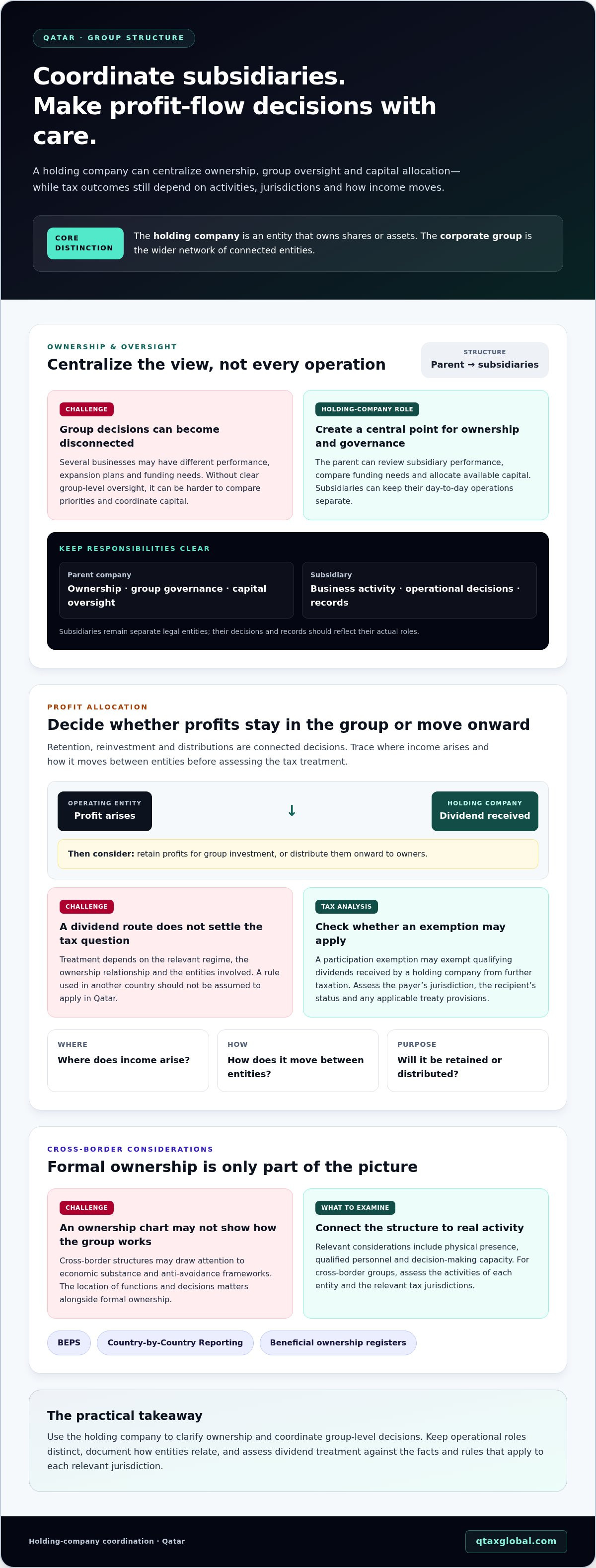
Cross-border structures also require attention to economic substance and anti-avoidance frameworks. BEPS, Country-by-Country Reporting, and beneficial ownership registers focus on real economic activity, including physical presence, qualified personnel, and decision-making capacity. For a Qatar-based group with cross-border entities, the location of functions and decisions matters as much as the formal ownership chart.
Ownership Structures Compared
Direct ownership places shares or property in individuals’ names; a holding company places ownership in a corporate entity. A trust instead uses a trustee to hold or manage assets under the trust arrangement. Compare these approaches by considering control, succession, administration, and the relationship between family members and operating businesses.
For example, a family that directly owns shares in several subsidiaries may need to coordinate decisions across those interests. A parent company can centralize the shareholdings and provide a corporate point for group governance. A trust may serve different succession or asset-management objectives, so the right approach depends on the family’s priorities for ownership and control.
Coordination of subsidiaries and reinvestment of profits
A holding company can coordinate subsidiary strategy, capital allocation, and decisions about retaining or distributing profits. For a Qatar-based group, the analysis depends on each entity’s activities and the relevant tax jurisdictions.
Subsidiary Control and Coordination
A holding company gives subsidiaries a central point for ownership and governance. This can help align group priorities while keeping each business’s day-to-day operations separate.
For example, a parent company could review one subsidiary’s expansion plans alongside another’s funding needs, then allocate available capital accordingly. Clear reporting lines help the parent compare performance and decide which entity should retain profits for investment. Subsidiaries remain separate legal entities, so their operational decisions and records should reflect their actual roles.
Dividend Participation Exemption
A participation exemption is a tax mechanism that may exempt qualifying dividends received by a holding company from further taxation. Whether it applies can affect decisions about retaining profits for group investment or distributing them onward.
The conditions and tax treatment depend on the relevant regime and ownership relationship. For a Qatar parent receiving a dividend from an overseas subsidiary, assess the payer’s jurisdiction, the recipient’s status, and any applicable treaty provisions. Do not assume a rule used abroad applies in Qatar. For example, the Netherlands has a participation exemption for qualifying shareholdings.
Capital gains on subsidiary shares also depend on the relevant jurisdiction’s rules and the facts of the disposal. Before planning a sale or restructuring, assess the seller, the shares, and any conditions for an exemption.
Loss Offsetting Between Subsidiaries
Loss offsetting allows losses in one company to reduce taxable profits elsewhere only when the governing tax regime permits it. This may matter when one subsidiary is investing or expanding while another earns taxable income.
For instance, if a Qatar group has a profitable trading subsidiary and a separate subsidiary making start-up losses, shared ownership alone does not mean the profits and losses can be combined. The applicable regime may set requirements for group relationships, filing, and eligible entities. Model each subsidiary separately before assuming losses can reduce another company’s tax base.
Cross-Border Income and Withholding Taxes
Cross-border rules determine how a subsidiary’s payments of dividends, interest, and royalties to its holding company are treated. For each payment, identify the payer and recipient, income type, residence, and any applicable treaty or CFC rules.
A treaty may affect withholding on a dividend or interest payment, while CFC rules may address certain income held through foreign entities. Royalty payments require their own analysis because they arise from intellectual property use, not share ownership. For a Qatar group paying across borders, cross-border tax structuring advisory can help assess these connected issues against the group’s ownership and income flows.
Tax treatment of profit distributions and dividends
A dividend’s treatment depends on the payer, recipient, and relevant tax jurisdiction. For a Qatar-based group, distinguish the company-level treatment from the tax position when an individual shareholder receives profits.
Dividends Between Resident Companies
Dividends between companies may be treated differently from distributions to individual shareholders. In the UK, dividends paid by a UK-resident subsidiary to its UK-resident holding company are not taxed.
This distinction can influence how a group transfers profits and retains capital for investment. For example, a UK subsidiary might distribute available profits to its UK parent, which then decides whether to reinvest or make a later shareholder distribution. This rule is specific to its jurisdiction and should not be assumed to apply to a Qatar entity or a cross-border payment.
Taxation of Shareholder Dividends
Shareholder taxation arises separately from a company’s treatment of dividends it receives. In the UK, the 2024-25 dividend tax rates are 8.75% for the basic-rate band, 33.75% for the higher-rate band, and 39.35% for the additional-rate band.
A group’s distribution strategy should distinguish dividends paid between companies from those received personally. For a family with individual owners, the amount and timing of a distribution affect when shareholder-level tax is considered. Record the recipient and the payment’s character before assessing its treatment.
Dividend Tax Exemption
A dividend exemption can prevent qualifying income received by a holding company from being taxed again, subject to specified conditions. For example, the Netherlands participation exemption exempts dividends and capital gains from qualifying shares.
That treatment is not universal. Spain’s example allows a 95% exemption on subsidiary dividends under certain conditions, while 5% remains taxable in the example. The relevant ownership, income, and jurisdictional conditions therefore matter. A Qatar group should not treat an overseas exemption as automatically available to its own entities.
Dividend Taxation Across Jurisdictions
Holding-company taxation varies by country because each jurisdiction sets its own rules for company income, exemptions, and shareholder distributions. The UK, Netherlands, and Spain examples above illustrate different approaches, not a single international standard.
For a Qatar group, analyze the payer’s and recipient’s jurisdictions, any applicable treaty, and whether profits stay within the corporate group or reach individual owners. Map each transfer from subsidiary to parent, then from parent to shareholder, and identify the tax treatment at every stage.
Holding-company implementation and annual costs
In Qatar, implementation starts by defining what the parent company will own and how it will operate. A parent that holds subsidiary shares has different administration needs from one that also owns property, receives income, or carries out business activities. Map each entity, asset, income stream, and decision-making responsibility before choosing a structure.
Setup involves documenting the ownership plan, assessing the appropriate entity arrangement, preparing incorporation materials, and organizing the transfer or subscription of subsidiary shares. The work depends on the existing group, intended ownership, asset types, and cross-border relationships. For example, inserting a parent above two operating companies requires analysis of both shareholdings and the intended flow of profits.
There is no single setup-cost figure that applies to every Qatar holding company. Costs depend on the number and complexity of entities, assets being transferred, required documentation, and tax analysis. For professional advisory services, the fee depends on the case and is provided after a quote request; relevant factors include group size, transaction history, and cross-border exposure.
Plan annual administration alongside incorporation, rather than treating it as an afterthought. A parent with several subsidiaries may need consolidated ownership records, board documentation, accounts, tax reporting, and records supporting intercompany transactions. For example, if the parent charges a subsidiary for management services, retain documentation explaining the service, allocation, and recorded payment.
Ongoing costs can include company administration, accounting and reporting, tax compliance, governance support, and records for related-party transactions. The number of subsidiaries, frequency of distributions, asset activity, and reporting obligations all shape the workload. A passive parent holding shares may need less recurring administration than one receiving multiple income streams or coordinating active businesses.
Use a practical planning sequence:
- Define the purpose: record whether the parent will hold shares, property, investments, or operating activities.
- Map ownership and flows: show who owns each entity and how dividends, expenses, and funding move.
- Assess implementation: identify transfers, agreements, tax questions, and records needed for the proposed structure.
- Budget recurring work: estimate administration by entity, reporting needs, transaction volume, and cross-border complexity.
Assess tax benefits against implementation and annual costs, rather than in isolation. A structure may improve oversight or support reinvestment, but additional entities also require separate records and administration. For a Qatar family group, compare expected income flows and governance needs with recurring compliance work to judge whether the parent-company arrangement is proportionate to its purpose.
What are the tax benefits and drawbacks of using a holding company?
A holding company can centralize ownership and support group decisions about dividends, funding, and strategic assets. For a Qatar-based group, any tax benefit depends on the entities, income flows, and jurisdictions involved; the structure itself does not create a universal exemption.
One potential benefit is keeping subsidiary profits within the group for future investment. A parent can direct available capital toward a subsidiary’s expansion or another group priority instead of distributing all profits to individual owners. This can support planning and governance, but it does not by itself establish a lower tax liability in Qatar.
Some jurisdictions have mechanisms that affect group taxation, including consolidated returns and deductions for qualifying dividends received. These rules vary by tax regime. A Qatar group with overseas subsidiaries should identify where each company is resident, where its income arises, and which conditions apply before treating a foreign exemption as a group-wide benefit.
Asset placement may also be a strategic consideration. Separating property or other valuable assets from operating activities can clarify ownership and risk allocation. However, separate entities bring separate records, governance responsibilities, and administration. Compare those ongoing obligations with the commercial purpose of holding the assets.
Tax costs can arise at more than one level. A non-trading holding company’s income may be subject to corporation tax, while a corresponding subsidiary expense may be deductible and reduce that subsidiary’s corporation-tax liability. If the holding company trades, it has corporation-tax obligations like other companies. The classification of income and activity therefore matters to the analysis.
Cross-border groups also need to consider anti-avoidance frameworks and economic substance. BEPS, Country-by-Country Reporting, and beneficial ownership registers focus on real economic activity, including physical presence, qualified personnel, and decision-making capacity. BEPS Pillar 2 is also relevant to multi-layered holding structures. A parent with formal ownership but limited corresponding activity may face questions about how the structure operates in practice.
Drawbacks include incorporation and administration costs, additional reporting, and the need to document transactions between related entities. A management charge, intercompany loan, or asset-use arrangement should have a clear business rationale and consistent records. These requirements can outweigh expected tax efficiencies for a group with few assets, limited subsidiary activity, or little need to reinvest.
Effective holding company tax structuring connects the group’s commercial purpose with its tax treatment, governance, and compliance obligations. A holding company tax structuring assessment can help decision-makers weigh those factors before implementation. Request a tax health check to assess the structure’s reporting, risk, and tax considerations.
QTAX GLOBAL: Tax Compliance and Reporting Services
QTAX GLOBAL supports Qatar businesses with Tax Compliance and Reporting Services, aligning reporting work with the group’s entities, income flows, and records. This is relevant when a holding company receives dividends, funds subsidiaries, or manages cross-border transactions that require consistent documentation.
A Tax Health Check Diagnostic can identify areas for further tax review, while Tax Audit & Dispute Resolution supports businesses responding to tax questions or disputes. For groups with international subsidiaries or transactions, Cross-Border Tax Structuring Advisory can assess how ownership and income flows interact across jurisdictions.
These services help finance teams connect a proposed structure with practical reporting and compliance requirements. To discuss your holding company’s tax and reporting needs, contact QTAX GLOBAL.
Set a Clear Basis for Your Next Decision
The next step is to turn the structure into a decision framework that owners, directors, and finance teams can apply consistently. Define who approves distributions, how reinvestment priorities are assessed, and which records support related-party transactions. For a family group, documenting these responsibilities can help maintain continuity when ownership or business priorities change.
Review the framework when the group considers an acquisition, a new cross-border arrangement, or a change in how assets are held. This gives decision-makers an opportunity to assess tax and reporting implications before making changes, rather than treating compliance as a separate exercise afterward. Effective holding company tax structuring remains connected to the group’s commercial purpose and governance.
QTAX GLOBAL offers Tax Compliance and Reporting Services, Tax Audit & Dispute Resolution, and a Tax Health Check Diagnostic to support relevant compliance and review needs. Contact QTAX GLOBAL about your structure to discuss a considered next step. Clear governance and well-organized reporting can help your group move forward with greater confidence.
Frequently Asked Questions
Family Holding: What is it and how does it work?
A family holding company is an entity through which family members hold interests in businesses or other assets. For a Doha family with interests in a trading business and commercial property, it can provide a shared ownership vehicle while each asset or business remains separately managed. Define decision rights, distribution policies, and succession expectations in the governing documents, and align them with the group’s actual ownership.
Should you transfer your personal investment portfolio to a Holdco?
Transfer a personal portfolio only after comparing the purpose and consequences of corporate ownership with retaining personal ownership. For example, a family considering moving listed shares should examine how the transfer is valued, how future income will be handled, and whether company reporting and administration are justified. Before deciding, consider the effects on investment access, control, succession planning, and eventual disposal.
What is a Holdco?
“Holdco” is an informal abbreviation for holding company. It usually refers to a company that owns shares in subsidiaries, although a holding company may also or instead hold assets such as property or investments. For example, if a Doha business owner places shares in two trading companies under one parent entity, that parent is the Holdco. The label alone does not determine its tax treatment or legal function.
What is a holding company and how is it taxed?
A holding company is a corporate entity that owns shares or other assets, and its tax treatment depends on its income and the relevant jurisdictions. A company receiving dividends, earning interest, or carrying out its own operations may face different tax considerations. For a Qatar-based group, identify each entity’s residence, activity, income source, and payment flows before assessing tax obligations. The word “holding” does not itself create a tax exemption.
How are dividends between a subsidiary and holding company taxed?
Treatment depends on where the subsidiary and holding company are resident, the character of the payment, and applicable domestic rules or treaty provisions. Assess a dividend paid by an overseas subsidiary to a Qatar parent separately from a later distribution to individual owners. Keep records of the payer, recipient, declared amount, and corporate approvals so the payment is accurately classified and reported in each relevant jurisdiction.
How does a holding company qualify for a participation exemption?
A participation exemption applies only when the relevant jurisdiction’s conditions are met; incorporation as a holding company is not enough. The rules may consider the ownership interest, subsidiary, income, and holding company’s status. Before relying on an exemption for a Doha group’s overseas shareholding, compare those facts with the jurisdiction’s specific requirements and retain records supporting the ownership and dividend received.
What tax risks arise when transferring assets or shares into a holding company?
Moving assets or shares into a company can have tax consequences depending on the asset, transaction structure, parties, and jurisdictions involved. Potential issues include capital gains, income tax, stamp duty, or inheritance tax. Transferring family-owned property and transferring subsidiary shares are different transactions, each requiring separate analysis. Document the asset’s ownership and transfer basis, then assess the consequences before completing the reorganization.
How are holding companies taxed on cross-border income under tax treaties and CFC rules?
Assess the payer and recipient, income type, residence, and applicable treaty or CFC rules. A treaty may affect withholding on dividends or interest, while CFC rules may address certain income held through foreign entities. Royalties require separate analysis.

