

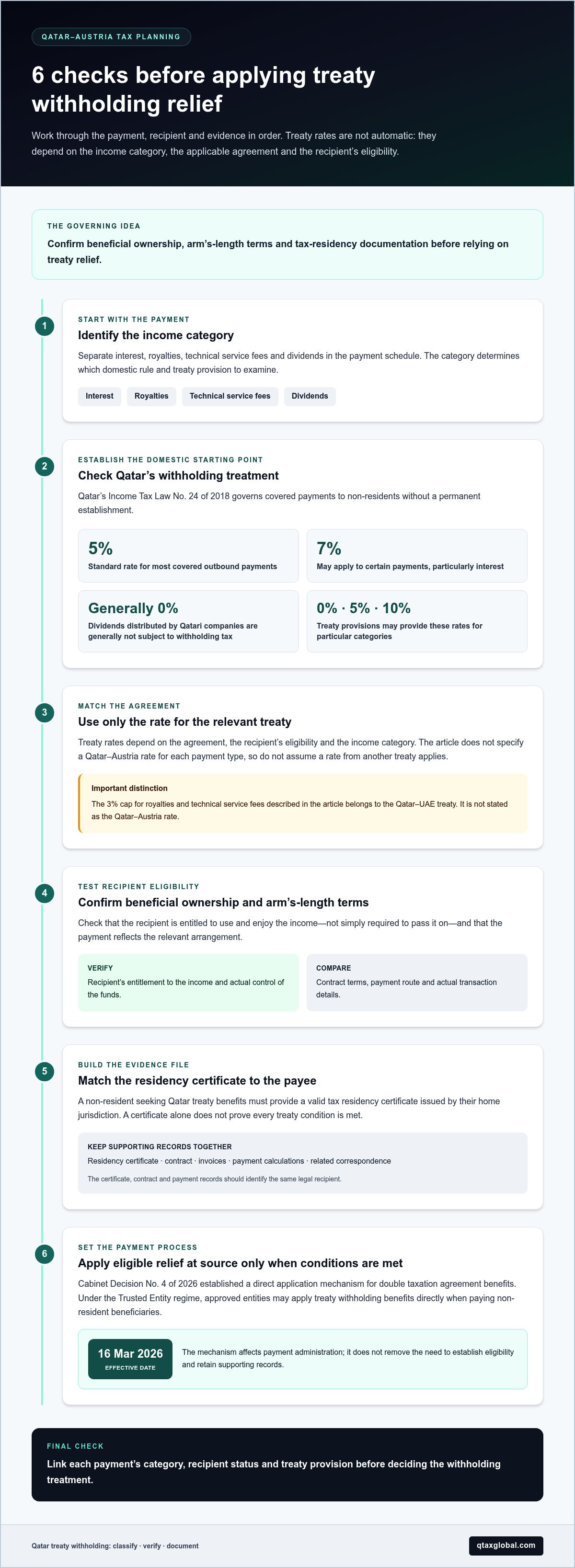
For Qatar tax treaty planning involving Austria, the central rule is that withholding tax relief depends on the recipient being the beneficial owner and the payment being at arm’s length. Certain Qatar payments, particularly interest, may be subject to a 7 percent withholding tax rate, while dividends distributed by Qatari companies are generally not subject to withholding tax. A non-resident seeking treaty benefits in Qatar must provide a valid tax residency certificate issued by their home jurisdiction.
A treaty’s practical effect depends on the payment type, the recipient’s status and the supporting documents. Its rates do not automatically apply to every cross-border transaction. This article explains how to assess withholding tax exposure, what the Qatar-Austria treaty update means for information exchange and planning, and which operational decisions to revisit when structuring payments and cross-border activity.
Key Takeaways
- Assess treaty relief by confirming beneficial ownership, arm’s-length payment terms and the recipient’s tax-residency documentation.
- Separate Qatar’s domestic withholding rules from treaty-specific rates; the standard rate for most covered outbound payments is 5 percent.
- Identify the income category before setting a payment approach, since certain interest payments may face 7 percent withholding while dividends from Qatari companies are generally not subject to withholding tax.
- Review how business profits and immovable property income are treated across borders, and consider how information exchange affects documentation and reporting.
- Use the treaty analysis to guide investor decisions on payment structures, operating models and cross-border compliance.
What the Qatar-Austria Tax Treaty Update Means for International Tax Planning ?
Qatar’s Income Tax Law No. 24 of 2018 sets domestic rules for withholding tax on certain payments to non-residents without a permanent establishment; an applicable agreement may provide relief when eligibility conditions are met. Qatar maintains tax treaties with more than 80 jurisdictions, and the General Tax Authority’s published treaty listings provide the current country list, including the relevant agreement for Austria.
Treaty Benefit Documentation
Treaty benefit documentation is evidence that a recipient submits to support reduced taxation under an agreement. In Qatar, a non-resident applicant must provide a valid tax residency certificate issued by their home jurisdiction. The certificate supports the claim that the recipient qualifies as a resident of the treaty partner state.
Before making a payment, match the certificate to the recipient named in the contract and payment records. Keep the agreement, invoices, payment calculations and related correspondence together so the payer can explain the tax treatment claimed. For example, an Austrian recipient claiming relief on a payment from Qatar should ensure that its residency certificate identifies the same legal entity receiving the income.
Treaty Eligibility and Beneficial Ownership
Treaty eligibility is the recipient’s entitlement to claim an agreement’s tax treatment for a particular type of income. Beneficial ownership means the recipient is entitled to use and enjoy that income, rather than acting as an intermediary that passes it on.
Treaty relief may depend on whether the recipient is entitled to the income and the payment reflects the relevant arrangement. A company should compare the contract, payment route and actual control of the funds. If an Austrian entity receives income but is required to transfer it under binding arrangements, it may be difficult to establish beneficial ownership.
Eligibility also depends on the relevant treaty article and income category. A residency certificate alone does not establish that every condition is met. The payer should link the recipient’s status and transaction details to the provision being claimed.
Anti-Abuse Rules and Benefit Risks
Anti-abuse rules prevent treaty rights from being used through arrangements whose main purpose is to secure tax advantages without substantive commercial reasons. Treaty benefits may be denied if eligibility conditions are not met or the transaction does not support the claimed entitlement.
For example, a change in the recipient, contractual rights or payment route can weaken an earlier claim. Qatar’s treaty with the UAE may deny benefits if obtaining them was one of the principal purposes of an arrangement or transaction. This provision is specific to that treaty and should not be treated as an Austria rule.
When structuring cross-border operations, document the commercial purpose, decision-making and allocation of income. Transfer pricing documentation and benchmarking can support the analysis of arm’s-length terms and related-party payments.
Treaty Benefits at Source
Treaty benefits at source apply the eligible treaty treatment when a Qatar payer makes or credits a payment, rather than relying solely on a later refund claim. Qatar’s Cabinet Decision No. 4 of 2026 amended the Executive Regulations to establish a direct application mechanism for double taxation agreement benefits.
Under the Trusted Entity regime, approved entities may apply treaty withholding tax benefits directly when paying non-resident beneficiaries. The regime was introduced through Cabinet Decision No. 4 of 2026, effective March 16, 2026. This mechanism can affect payment administration, but it does not remove the need to establish treaty eligibility and retain supporting records.
For Qatar tax treaty planning, map each payment to its income category, recipient and applicable agreement before paying it. This helps align withholding decisions, supporting documents and operating arrangements.
Withholding tax rates on royalties and technical service fees
Withholding tax is tax deducted from certain payments made to non-residents before payment. In Qatar, Income Tax Law No. 24 of 2018 governs withholding tax on covered payments by Qatari entities to non-residents without a permanent establishment. The standard rate for most covered outbound payments is 5 percent of the gross payment.
Treaty rates depend on the agreement, recipient eligibility and income category. Qatar treaty provisions may provide rates of 0 percent, 5 percent, or 10 percent for particular categories. Certain Qatar payments, particularly interest, may be subject to a 7 percent withholding tax rate. These figures are not interchangeable: identify the payment and applicable agreement before calculating the deduction.
For royalties and technical service fees, the Qatar-UAE treaty caps source-state taxation at 3 percent. That rate belongs to the Qatar-UAE agreement; it should not be applied automatically to an Austrian recipient or treated as the Qatar-Austria rate. For a Qatar-Austria payment, classify the income under the relevant treaty provision, then apply its terms alongside domestic rules.
Dividends distributed by Qatari companies are generally not subject to withholding tax. This domestic treatment differs from treaty rate limits that may apply to dividends in other circumstances or jurisdictions. Record interest, royalties, service fees and dividends as separate categories in cross-border investment schedules.
Qatar withholding tax is typically due by the 16th day of the month following the payment. A payer can build this deadline into its accounts-payable process by recording payment dates, recipient residence, gross amounts and tax treatment together. For example, a payment made during one month should be included in the following month’s withholding-tax calendar.
Under-withholding creates a compliance risk if the deduction and remittance do not match the payment’s correct treatment. The available facts establish Qatar’s withholding framework but do not specify a penalty amount, so do not assume one. Reconcile contracts, invoices, payment records and the treaty provisions applied, and retain the calculation explaining any relief claimed.
Before releasing funds, use a practical review sequence:
- Classify the payment as interest, dividend, royalty, technical service fee or another category.
- Identify the recipient’s jurisdiction and determine whether treaty relief conditions are met.
- Calculate withholding on the gross payment, document the basis and diarise the 16th-day deadline.
For border investment involving related parties, align payment terms with the underlying transaction and maintain evidence supporting the rate applied. A focused cross-border tax structuring review can help connect treaty classification, payment processes and reporting records.
Recent Changes to the Qatar-Austria Tax Treaty: Why Businesses Should Pay Attention?
A tax treaty allocates taxing rights between jurisdictions and can address double taxation on cross-border income. For Qatar and Austria, assess the applicable agreement’s wording alongside Qatar’s domestic rules. Do not assume that a change affecting another treaty applies here.
Qatar’s bilateral tax agreements are intended to address double taxation of investor income in the country of residence and the country where the activity is conducted. The taxes covered are those identified in each agreement; therefore, check its covered-tax provisions and relevant income articles before applying treaty relief. Qatar’s Income Tax Law No. 24 of 2018 provides the domestic framework for income taxation.
Business profits are income arising from an enterprise’s commercial activities. Treaty provisions determine when the state where those activities occur may tax the profits, so distinguish treaty rules from domestic taxation. For comparison, the Qatar-UAE treaty provides that business profits are taxable only in the enterprise’s state of residence, unless they are attributable to a permanent establishment in the other country. That rule belongs to the Qatar-UAE agreement and does not automatically apply to Qatar-Austria operations.
Immovable property income is income connected with land or buildings. Treaty treatment depends on the applicable agreement and the property’s location, so identify property-related receipts separately from operating profits. The Qatar-India treaty allows the state where immovable property is situated to tax gains from its sale. This illustrates a treaty-specific allocation, not a universal rule for every Qatar agreement.
Income taxable in Qatar is income that falls within Qatar’s tax rules. Foreign tax paid on income taxable in Qatar is deductible as an expense when determining taxable income. Record the foreign tax alongside the related income, then assess whether that income is taxable under Qatar law before including the deduction in the tax computation.
Foreign tax deductibility is an expense treatment, not the same mechanism as a treaty credit. For example, the Qatar-UAE treaty provides a foreign tax credit limited to the residence state’s own tax on the relevant income or capital. Do not treat that treaty-specific credit as the general Qatar-Austria outcome. Identify the relief mechanism under the relevant agreement.
Maritime and air transport income is earned from operating ships or aircraft in international traffic. For a Qatar-based business, separate transport receipts from property income and ordinary operating profits, then review the relevant treaty article and the operator’s residence. Do not apply another jurisdiction’s allocation rule without matching it to the agreement governing the transaction.
For an international review, map each income stream, its source, the taxpayer’s residence and any foreign tax paid. This gives global businesses a consistent basis for treaty analysis, domestic tax calculations and coordination between finance and tax teams.
How the Update Affects Cross-Border Tax Planning?
Qatar’s 2026 changes establish a direct application mechanism for double taxation agreement benefits. Investors should assess eligibility, payment flows and operating obligations together before changing a cross-border structure.
Investor Cross-Border Tax Planning
Cross-border tax planning assesses tax obligations arising when investment income connects multiple countries. Investors should map the income source, recipient, residence and payment route against the relevant agreement.
Qatar Cabinet Decision No. 4 of 2026 amended the Executive Regulations of the Income Tax Law to establish this direct application mechanism. Under Qatar’s Trusted Entity regime, approved entities may apply treaty withholding tax benefits directly when paying non-resident beneficiaries. The regime was introduced through Cabinet Decision No. 4 of 2026, effective March 16, 2026.
Investors should distinguish treaty entitlement from the administrative process used to apply it. Direct application can inform payment procedures, but the recipient and income must still meet the relevant treaty conditions.
Cross-Border Investment Structures
A cross-border investment structure consists of entities, contracts and cash flows arranged across jurisdictions. Its tax outcome depends on who earns and receives the income, and where business activity takes place.
Before investing, compare the proposed structure with the commercial function of each entity. For example, if one company owns an investment and another receives related payments, document each entity’s role and the basis for allocating income. This supports a clear assessment of treaty access and reporting obligations.
The direct application mechanism makes payment administration part of tax planning, not merely a year-end calculation. Investors should establish whether the payer qualifies under the Trusted Entity regime and align payment instructions with the recipient’s treaty claim. This helps finance teams maintain consistent records across countries.
Effects on Cross-Border Investment
Cross-border investment can be affected by changes in tax administration, cash flow and compliance responsibilities arising from treaty treatment. A direct application process may change how an eligible payer handles withholding when paying non-residents.
Before implementation, review payment schedules, recipient documentation and internal approval controls. Distinguish Qatar’s administrative amendment from treaty-specific terms, as each agreement sets its own substantive rights and conditions.
Qatar tax treaty planning should connect the investment rationale with expected income flows and the payer’s processes. A review can identify where the structure, documentation or responsibilities need to align, supporting operational consistency without treating tax relief as automatic.
Exchange of tax information
Tax information exchange is the sharing of relevant taxpayer information between jurisdictions under applicable legal mechanisms. For Qatar-Austria operations, businesses should distinguish information-sharing provisions from rules that allocate taxing rights or reduce double taxation. Qatar maintains tax treaties with more than 80 jurisdictions, but each agreement’s wording determines its specific scope.
Exchange on request is a process in which one jurisdiction asks another for information relevant to a tax matter. A request may cover records needed to examine income tax treatment, such as ownership details, contracts or financial transactions. Keep those records consistent across accounting systems, tax filings and related-party agreements so the transaction under review can be traced.
For example, if an Austrian entity receives income linked to activity in Qatar, its contracts, invoices and payment records should explain the recipient, commercial purpose and amount. Qatar and Austria apply the procedures set by the relevant agreement and domestic rules. Records that clearly connect a payment to its accounting entry can help explain how the business treated that income.
Automated information exchange is the periodic transmission of defined financial information between jurisdictions without a separate request for each record. It differs from exchange on request in timing and process. The specific categories, participants and procedures depend on the legal arrangement governing the exchange. Do not assume that every treaty provides the same mechanism.
For Qatar-Austria planning, identify whether a relevant information-exchange provision applies and which authorities can use it. Then align financial records with tax returns, ownership information and supporting contracts. Inconsistent entity names, payment descriptions or accounting periods can make a transaction harder to reconcile across jurisdictions, even when the underlying figures agree.
Information exchange does not itself determine whether income is taxable in Qatar or Austria. Applicable income tax rules and treaty provisions address that separate question. However, a tax authority’s access to relevant information can support its review of residence, income source, beneficial ownership and treaty claims. Maintain a clear audit trail for every cross-border payment and its tax treatment.
Businesses can strengthen transparency through a practical records process:
- Link each cross-border payment to its contract, invoice and accounting entry.
- Keep recipient and ownership details aligned across filings and company records.
- Record the treaty provision and tax treatment applied to each income category.
These procedures support consistent reporting and help tax teams respond to information requests with a coherent transaction record. To assess how your documentation and controls support cross-border reporting, review your tax compliance processes.
QTAX GLOBAL: Tax Compliance and Reporting Services
QTAX GLOBAL supports Qatar businesses through Tax Compliance and Reporting Services when cross-border payments, treaty positions or reporting obligations require a structured review. This work can help align tax records with payment classifications, supporting documents and the treatment applied to each income stream.
For an investment or operating arrangement spanning Qatar and Austria, Cross-Border Tax Structuring Advisory can assess how the structure, cash flows and tax obligations fit together. A Tax Health Check Diagnostic can also help identify inconsistencies between reporting records and positions used to claim treaty relief. If a tax authority challenges a filing or treatment, Tax Audit & Dispute Resolution addresses the related tax issue.
For a considered review of your Qatar cross-border tax position, contact QTAX GLOBAL.
Turn Treaty Analysis Into Ongoing Governance
A sound cross-border tax position should stay connected to commercial decisions as investments, contracts and reporting processes evolve. Make treaty analysis part of governance by assigning responsibility for maintaining transaction records, reviewing changes to payment arrangements and aligning tax positions with financial reporting. This makes Qatar tax treaty planning an ongoing discipline rather than a one-time structuring exercise.
QTAX GLOBAL provides Tax Compliance and Reporting Services, a Tax Health Check Diagnostic and Tax Audit & Dispute Resolution. These services can support businesses assessing reporting controls, identifying inconsistencies or addressing a tax authority challenge. The next step depends on the issue under review and the records available for assessment.
For a structured discussion of your Qatar tax position, contact QTAX GLOBAL for tax planning. A clear review can help your team move forward with considered decisions and stronger internal alignment.
Frequently Asked Questions
How Businesses Should Adjust Their Tax Strategy?
Connect treaty analysis to investment decisions, payment controls and reporting responsibilities. For Qatar tax treaty planning, start by assigning each income stream to the entity that earns and receives it, then document the commercial reason for the arrangement. A Doha-based group can map planned payments against contracts and accounting records before approving transactions. Revisit the analysis when ownership, financing terms or business activities change, as these changes can affect the facts supporting a tax position.
How do Qatar tax treaties define tax residency and determine treaty residence?
Treaty residence is determined under the residence article of the specific agreement, using its definition and any applicable resolution rules. Distinguish a company’s place of incorporation, effective management and tax residence rather than treating them as interchangeable. If an individual or entity has connections to both countries, review the treaty’s tie-breaker wording and retain evidence supporting the relevant facts. Do not apply another Qatar treaty’s residence test to the Qatar-Austria analysis.
What are the requirements for obtaining a Qatar tax residency certificate?
A non-resident seeking treaty benefits in Qatar must provide a valid tax residency certificate issued by their home jurisdiction. For a Qatar resident seeking a certificate for use abroad, the receiving country’s treaty claim depends on its own requirements and the certificate’s purpose. Keep the certificate aligned with the legal name and tax period used in contracts, invoices and filings. A mismatch can complicate the recipient’s evidence even when the underlying residence position is consistent.
How do Qatar treaties address permanent establishment and business profits?
Treaties generally use a permanent establishment article to determine when business activity in another state gives that state taxing rights over attributable profits. The precise threshold and activities depend on the agreement, so compare the relevant treaty article with actual operations. Project duration, staff presence, contract authority and the location of business functions can shape the analysis. Record these facts as they arise, rather than reconstructing them after a tax review begins.
What treaty benefits and limitation-of-benefits or principal-purpose tests apply in Qatar?
Treaty benefits depend on the agreement’s conditions, the income category and the recipient’s entitlement. The Qatar-UAE treaty may deny benefits if obtaining them was one of the principal purposes of an arrangement or transaction. This wording is specific to the Qatar-UAE agreement and should not be assumed to govern Qatar-Austria transactions. For any structure, retain evidence of commercial objectives, decision-making and the recipient’s role alongside the treaty claim.
How can a company claim treaty relief or a withholding tax refund in Qatar, and what documents are required?
A company should establish eligibility, assemble transaction records and apply the relevant treaty mechanism. Qatar’s Trusted Entity regime permits approved entities to apply treaty withholding benefits directly when paying non-resident beneficiaries. A supporting file should link the recipient’s valid home-jurisdiction tax residency certificate to the contract, invoice, payment calculation and accounting entry. For a refund claim, reconcile the amount withheld and remitted with the treatment claimed, and retain evidence supporting any difference.
What are the tax treaty planning risks in Qatar, including anti-avoidance rules and transfer pricing?
Key risks include claiming relief without beneficial ownership, applying a treaty article to the wrong income category, and using related-party terms that do not reflect an arm’s-length payment. These issues can undermine the tax position and create inconsistencies between contracts, tax filings and actual cash flows. For related-party transactions, preserve the commercial rationale, pricing method and evidence of the functions performed. Review the arrangement when the parties’ roles or payment terms change, not only at year-end.
How do Qatar tax treaties compare for holding companies, financing, and cross-border investment?
Compare treaties by the income involved and the rights each agreement grants, rather than assuming one jurisdiction offers a universal advantage. For a holding company, assess dividend and share-disposal provisions; for financing, examine interest treatment and recipient eligibility. Investors should also evaluate substance, decision-making and operational responsibilities across the structure. A comparison matrix covering Qatar and each counterparty country can reveal differences in treaty conditions before investment documents and payment arrangements are finalized.

